
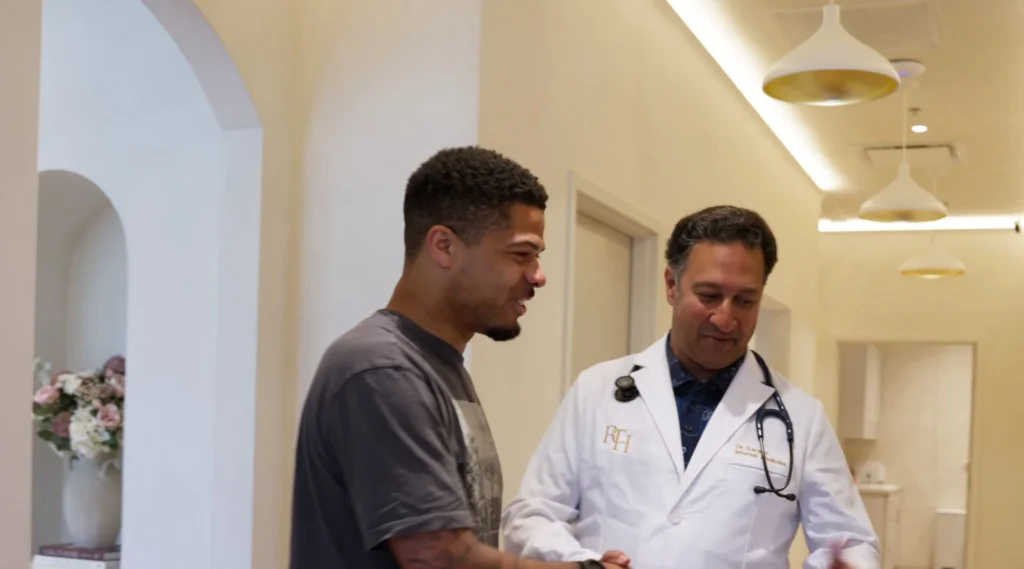
Low energy does not automatically mean low testosterone
Men see advertisements connecting testosterone with almost every aspect of health:
Energy.
Strength.
Mood.
Weight.
Sex drive.
Confidence.
Some men genuinely have testosterone deficiency and benefit from appropriate treatment.
But those symptoms are not specific to testosterone.
Fatigue can be caused by sleep apnea.
Reduced libido can involve medications, depression, relationship factors, vascular disease, stress, or hormonal issues.
Difficulty gaining muscle can involve age, training, nutrition, sleep, or chronic illness.
That is why an actual medical evaluation matters.
How is low testosterone diagnosed?
The Endocrine Society recommends diagnosing hypogonadism only when symptoms or signs consistent with testosterone deficiency occur along with unequivocally and consistently low testosterone concentrations.
It also recommends confirming low testosterone with repeat morning testing. Its July 2026 statement again emphasized symptoms plus consistently low, accurately measured testosterone rather than population-level screening of asymptomatic men.
One low number is not automatically a diagnosis.
What symptoms should I discuss with my doctor?
Potential concerns can include:
- Reduced sexual desire
- Erectile or sexual-health changes
- Low energy
- Reduced strength
- Changes in body composition
- Mood changes
- Fertility concerns
- Reduced spontaneous erections
- Other symptoms associated with testosterone deficiency
The physician should ask when symptoms began and what else changed at the same time.
What else can affect testosterone?
Hormones exist within a larger health system.
Testosterone can be influenced by factors such as:
Sleep
Poor sleep and sleep disorders can affect energy, sexual health, metabolism, and hormonal function.
Body composition
Obesity and metabolic health can interact with testosterone levels.
Medication
Some medications can affect sexual function or hormone production.
Chronic illness
Systemic health problems can influence testosterone.
Pituitary or testicular conditions
When testosterone is truly low, additional evaluation may be required to understand why.
The Endocrine Society recommends distinguishing primary from secondary hypogonadism and investigating the cause rather than stopping at the testosterone number.
What is TRT?
TRT stands for testosterone replacement therapy.
It is medical treatment intended to restore testosterone in appropriately selected men with diagnosed deficiency.
Treatment can use different formulations and requires monitoring.
TRT should not be marketed as a general anti-aging treatment for every man experiencing normal changes with age.
What should be discussed before TRT?
A consultation should include:
- Fertility plans
- Prostate-health considerations
- Cardiovascular history
- Sleep apnea
- Blood counts
- Medication use
- Symptoms
- Baseline testosterone
- Other relevant laboratory results
- Expected benefits
- Potential risks
- Monitoring plan
Fertility deserves particular attention because external testosterone can suppress sperm production.
The Endocrine Society recommends against starting testosterone therapy in men planning fertility in the near term.
What does “beyond TRT” actually mean?
It means men’s health should not become a testosterone subscription.
A complete plan may involve:
- Improving sleep
- Treating sleep apnea
- Weight management
- Strength training
- Nutrition
- Mental-health care
- Cardiovascular-risk reduction
- Diabetes prevention or treatment
- Sexual-health evaluation
- Reviewing medications
- Treating a confirmed hormone disorder when appropriate
Sometimes TRT will be part of the answer.
Sometimes it will not.
Men’s hormone health at Renova Total Health in Carmel
Renova Total Health currently provides hormone therapy within its physician-led medical model in Carmel.
The advantage of approaching men’s hormone health within a multispecialty practice is that hormonal symptoms can be evaluated alongside Internal Medicine, metabolic health, weight management, sleep concerns, mental health, and longer-term preventive goals.
That makes the question larger than:
“How do I raise my testosterone?”
A better question is:
“Why do I feel different, and what does my health actually need?”
Frequently Asked Questions
How is low testosterone diagnosed?
Diagnosis generally requires symptoms or signs consistent with testosterone deficiency plus consistently low testosterone confirmed with appropriate laboratory testing.
Is one low testosterone test enough?
Usually not. Clinical guidelines recommend confirming a low result with repeat morning testosterone testing before diagnosing testosterone deficiency.
Does fatigue mean I need testosterone?
No. Fatigue has many possible causes, including poor sleep, sleep apnea, depression, medications, anemia, thyroid disease, metabolic conditions, and other health problems.
Can testosterone therapy affect fertility?
Yes. External testosterone can suppress sperm production, so fertility plans should be discussed before treatment.
Is TRT an anti-aging treatment?
TRT is a medical treatment for appropriately diagnosed testosterone deficiency. It should not be assumed to be appropriate for every man experiencing normal age-related changes.
Where can I discuss men’s hormone therapy in Carmel, IN?
Renova Total Health in Carmel offers physician-led hormone evaluation and treatment within a broader internal-medicine, metabolic-health, and longevity-care model.