
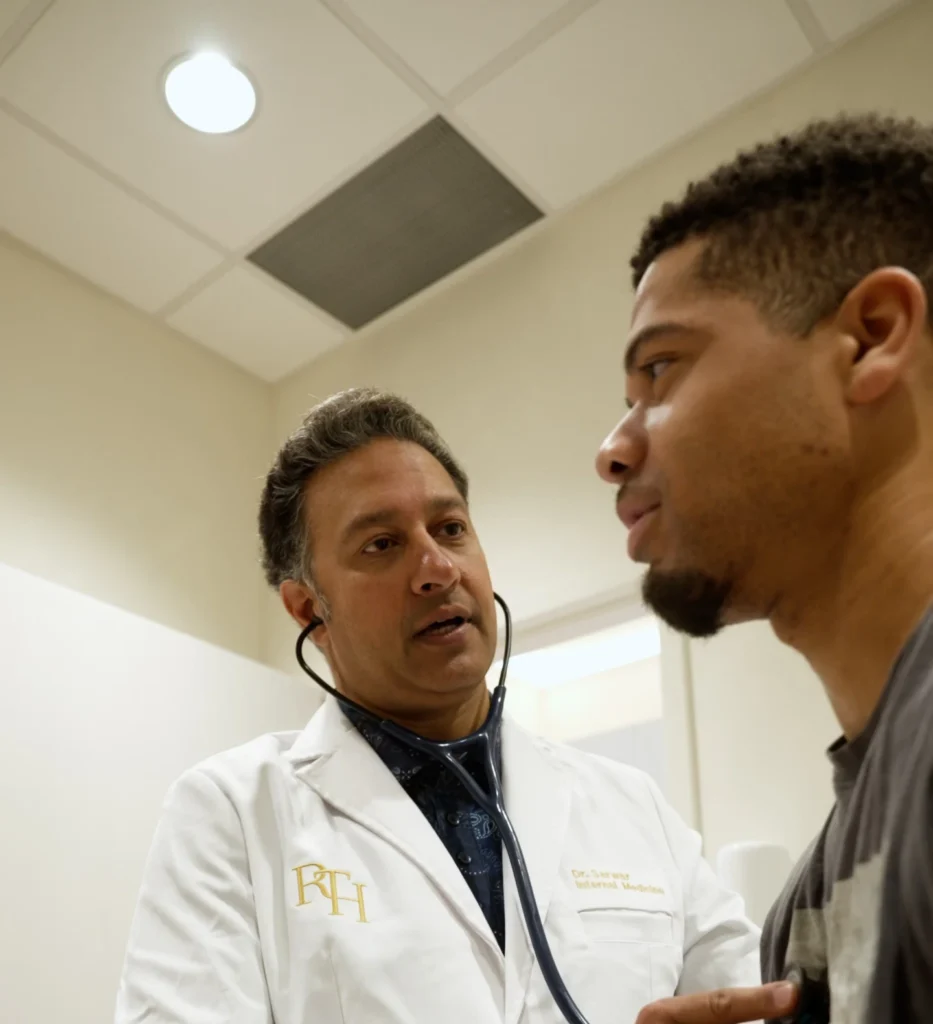
Longevity medicine should start with prevention
The most useful idea behind longevity medicine is surprisingly simple:
Do not wait for poor health to become advanced before paying attention to it.
Traditional medicine already includes prevention. Blood-pressure treatment, cancer screening, vaccination, cholesterol management, diabetes prevention, smoking cessation, and lifestyle counseling are all preventive medicine.
Longevity-focused care builds on that foundation by asking a longer-term question:
What can we do today to preserve health, mobility, cognition, metabolic function, and independence years from now?
At Renova Total Health in Carmel, Indiana, longevity care is designed around comprehensive diagnostics, physician assessment, personalized intervention, and ongoing monitoring rather than a single treatment or supplement.
Does “prevention over prescription” mean avoiding medication?
No.
Prevention and medication are not opposites.
Sometimes one of the most effective ways to prevent future disease is to prescribe appropriate treatment now.
Blood-pressure medication can reduce cardiovascular risk. Lipid-lowering treatment may be appropriate for some patients. Diabetes medication can be part of metabolic-risk management. Hormone therapy can have an appropriate role for carefully selected patients.
The goal of preventive longevity medicine is not to reject medication.
It is to avoid reducing healthcare to medication alone.
Depending on the person, prevention may involve:
- Sleep
- Nutrition
- Strength and cardiovascular fitness
- Weight management
- Blood-pressure control
- Lipid management
- Mental health
- Smoking or alcohol counseling
- Preventive screenings
- Vaccination
- Appropriate prescription therapy
- Musculoskeletal health
- Hormonal care when medically indicated
The strategy should follow the patient’s actual risks.
What does a longevity-focused physician look for?
A physician should begin with the same fundamental tools that underpin good medicine:
Medical history
Family history, previous diagnoses, medications, past procedures, symptoms, and lifestyle all affect risk.
Current measurements
Blood pressure, weight trends, body composition when useful, laboratory results, sleep, activity, and other measurable factors help establish a baseline.
Preventive needs
Screening needs change with age, sex, personal history, and family history.
Early risk factors
The goal is to recognize concerning trends before they become more advanced disease.
A laboratory result should never be interpreted without context.
A mildly abnormal value may be highly relevant for one person and much less significant for another.
Are more tests always better for longevity?
No.
One of the risks of the longevity industry is assuming that a longer laboratory order automatically creates better medicine.
Testing is useful when the result can answer a meaningful clinical question.
Renova Total Health currently offers laboratory categories including metabolic, cardiovascular-risk, thyroid, hormone, nutrient, and longevity-focused panels, but its process emphasizes physician selection based on the patient’s history and goals.
That distinction matters.
The goal is useful data, not maximal data.
What should a preventive longevity plan include?
A useful plan is usually layered.
First: protect the basics
Blood pressure, metabolic health, cardiovascular risk, cancer screening, sleep, nutrition, activity, and mental health remain foundational.
Second: investigate individual concerns
Fatigue, weight change, declining exercise tolerance, sleep problems, sexual-health concerns, chronic pain, or cognitive symptoms may warrant additional evaluation.
Third: personalize intervention
Different patients may need lifestyle changes, medication, rehabilitation, hormonal treatment, weight management, specialist care, or another targeted intervention.
Fourth: monitor
Longevity care is longitudinal.
The purpose of follow-up is to determine whether the plan is working and whether risks are moving in the right direction.
Renova’s current longevity framework similarly emphasizes comprehensive labs, physician assessment, targeted treatment, and ongoing monitoring.
When should someone begin thinking about longevity?
There is no required age.
A healthy person in their 30s may primarily benefit from establishing strong habits and understanding family risk.
Someone in their 40s or 50s may begin paying closer attention to cardiometabolic health, hormonal transition, body composition, strength, sleep, and preventive screening.
An older adult may increasingly focus on mobility, muscle preservation, cognition, bone health, medication management, and independence.
Longevity medicine should evolve with the patient.
Preventive longevity medicine at Renova Total Health
Renova Total Health is a physician-led multispecialty medical practice in Carmel, Indiana.
Its clinical model combines Internal Medicine, Gynecology, Psychiatry, and musculoskeletal care with longevity and functional-health thinking across specialties.
This allows prevention to become more coordinated.
Instead of treating blood pressure, menopause, anxiety, chronic pain, body composition, and laboratory trends as unrelated concerns, the care team can consider how each affects the patient’s larger health trajectory.
That is ultimately the purpose of longevity medicine:
not simply adding years to life, but protecting the health that makes those years valuable.
Frequently Asked Questions
What is preventive longevity medicine?
Preventive longevity medicine is a physician-led approach focused on identifying health risks early and supporting long-term health and function through prevention, appropriate testing, lifestyle strategies, treatment, and ongoing monitoring.
Is longevity medicine anti-medication?
No. Prescription treatment can be an important part of disease prevention when medically appropriate. Longevity care aims to use medication thoughtfully alongside prevention and lifestyle rather than viewing the two as opposites.
Do I need extensive lab testing for longevity medicine?
Not necessarily. Testing should be selected according to medical history, symptoms, family risk, age, medications, and the clinical question being evaluated.
Is longevity medicine only for older adults?
No. Preventive risk management can be useful throughout adulthood, although priorities change with age and individual health needs.
What is healthspan?
Healthspan refers to the portion of life spent in relatively good health and function. Longevity medicine commonly emphasizes preserving healthspan rather than focusing only on lifespan.
Where can I discuss longevity medicine in Carmel, IN?
Renova Total Health in Carmel provides physician-led, longevity-forward care through a multispecialty model focused on prevention, personalized diagnostics, ongoing monitoring, and long-term health.