
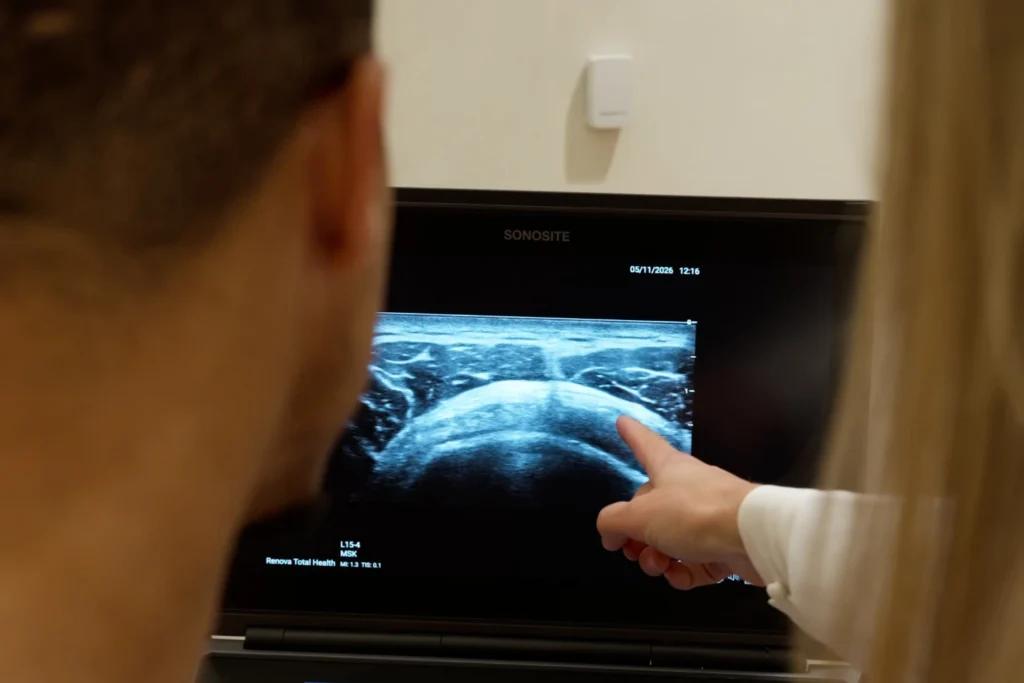
Prolotherapy is an injection technique in which an irritant solution—commonly containing dextrose—is placed into selected painful ligaments, tendons, joints, or related structures with the goal of stimulating a localized healing response. It is sometimes grouped with regenerative treatments, but evidence varies by condition. Diagnosis and proper patient selection are essential before treatment.
What is prolotherapy?
Prolotherapy is a musculoskeletal injection treatment.
A clinician injects a solution, commonly containing dextrose, into selected tissues thought to be contributing to pain or instability.
The treatment is based on the concept that a controlled local stimulus may encourage biological repair activity.
That is why prolotherapy is often described as “regenerative.” The word should be interpreted carefully: prolotherapy does not guarantee regeneration of cartilage, reversal of arthritis, or reconstruction of a torn ligament.
The intended biological response and the clinically proven outcome are not always the same thing.
What is in a prolotherapy injection?
Formulations vary.
Dextrose is one of the most commonly discussed components. Depending on the clinician and indication, other ingredients may also be used.
Patients should ask exactly what will be injected, at what concentration, and why that formulation was selected.
What conditions may be considered for prolotherapy?
Renova Total Health describes prolotherapy within its physician-led Physical Medicine & Rehabilitation and regenerative-care model for selected concerns involving areas such as:
- Low back
- Neck
- Shoulder
- Knee
- Hip
- Elbow
- Achilles region
- Plantar fascia
- Sacroiliac region
- Chronic joint or soft-tissue pain
That list describes potential clinical consideration—not a guarantee that prolotherapy is appropriate for every pain condition.
Pain can come from arthritis, tendon disease, nerve problems, fractures, inflammatory conditions, referred pain, instability, muscle dysfunction, or many other causes.
The diagnosis comes first.
What does the evidence say?
Evidence is mixed and condition-specific.
For some musculoskeletal conditions, individual studies have reported improvement. For others, evidence remains limited, inconsistent, or difficult to interpret because protocols vary.
The National Center for Complementary and Integrative Health has noted conflicting evidence for prolotherapy in chronic low-back pain.
A responsible treatment discussion should therefore avoid describing prolotherapy as a universally proven solution.
Instead, the physician should explain:
- Why this tissue is believed to be causing symptoms
- What evidence exists for that diagnosis
- What alternatives are available
- What outcome would count as success
- When the plan should be reconsidered if improvement does not occur
What happens during prolotherapy?
At Renova Total Health, prolotherapy is described as an ultrasound-guided treatment.
A typical process may include:
Evaluation
The physician reviews pain pattern, injury history, prior treatment, physical findings, health history, and imaging when relevant.
Target identification
The clinician determines which ligament, tendon, joint, or related structure is being targeted.
Ultrasound guidance
Ultrasound may be used to visualize anatomy and guide injection placement.
Injection
The selected solution is delivered to the target area.
Recovery and reassessment
The patient receives instructions for activity and follow-up.
What does recovery feel like?
Temporary soreness or stiffness can occur after treatment.
Renova’s current treatment information describes post-procedure soreness or stiffness that may last approximately 24 to 72 hours for some patients, with return to normal activity depending on the treatment area and individual response.
Protocols vary, so the patient’s own instructions should take priority over generic guidance.
How many prolotherapy treatments are needed?
There is no universal number.
Some protocols use a series of injections spaced over time. Others may be reconsidered after an initial treatment depending on response.
A predetermined package should not replace clinical reassessment.
The decision to continue should be based on meaningful measures such as:
- Pain with activity
- Range of motion
- Strength
- Stability
- Ability to exercise
- Ability to perform daily tasks
Is prolotherapy the same as PRP?
No.
Prolotherapy commonly uses a dextrose-containing solution to create a local stimulus. PRP uses platelet-rich plasma prepared from the patient’s own blood.
Both may be discussed under a broader regenerative or orthobiologic umbrella, but they use different substances and have different evidence depending on the condition.
One is not automatically “stronger” or “better.”
Why consider prolotherapy at Renova Total Health in Carmel?
Prolotherapy at Renova is part of a larger PM&R and sports-medicine approach.
That means an injection can be combined with—or replaced by—other strategies such as:
- Rehabilitation
- Strength work
- Mobility treatment
- Biomechanical assessment
- PRP when appropriate
- Activity modification
- Broader health and recovery planning
For someone searching “prolotherapy near me,” that integrated model matters. The goal is not simply to find someone who offers injections. It is to find a clinician who can determine whether an injection is actually the right tool.
Frequently Asked Questions
What is prolotherapy?
Prolotherapy is an injection technique that commonly uses a dextrose-containing solution in selected painful ligaments, tendons, joints, or related structures with the goal of stimulating a localized healing response.
Is prolotherapy proven to regrow cartilage?
No. Prolotherapy should not be described as a guaranteed way to regrow cartilage or reverse advanced arthritis. Evidence varies by diagnosis and treatment protocol.
Is prolotherapy the same as PRP?
No. Prolotherapy commonly uses a dextrose-based solution, while PRP uses platelet-rich plasma prepared from the patient’s own blood.
How long are you sore after prolotherapy?
Temporary soreness or stiffness is common. Renova Total Health’s current protocol information notes that some patients may experience soreness for approximately 24 to 72 hours, although recovery varies.
How many prolotherapy treatments do you need?
There is no universal number. Some patients may be treated in a series, but continuation should depend on diagnosis, response, functional improvement, and physician reassessment.
Who offers prolotherapy in Carmel, IN?
Renova Total Health in Carmel offers ultrasound-guided prolotherapy within its physician-led Physical Medicine & Rehabilitation and musculoskeletal-care model.
Next step: Learn about Prolotherapy at Renova Total Health or request a consultation.
Related reading